The Launch of Proton Therapy This Year: A Strategic Pillar for Precision Care, Sustainability, and Treating More Children
Delivering Ambulatory Clinical Services — Proton Therapy, CyberKnife, Laboratory, Imaging, and Radiation Therapy for Adults — with 57357 Quality and Preferential Pricing to Sustain Free Pediatric Care Without Impacting Core Bed Capacity (300 Beds)
At 57357, every story begins and ends with one uncompromising promise: every child with cancer receives all treatment services completely free of charge, without exception. This promise has never been a slogan; it has been a living commitment sustained for years by faith, donor generosity, and the extraordinary dedication of our teams. Yet amid global economic shifts, rising healthcare costs, and increasing donor fatigue worldwide, it became clear that compassion alone — however powerful — would no longer be sufficient to safeguard this promise for future generations. Sustainability was no longer merely a financial discussion; it became an ethical responsibility.
Today, 57357 achieves a pediatric cancer survival rate of 71.21% — a number that represents thousands of saved lives and families kept whole. Globally, however, leading pediatric oncology centers report survival rates between 80% and 85%. This gap is not just statistical; it represents children who could live longer, dreams that could continue, and futures that can still be rewritten. Closing this gap requires continuous investment in advanced technologies, highly specialized clinical expertise, robust safety systems, and globally aligned standards of care — while preserving the hospital’s absolute principle: free, comprehensive treatment for every child. As promised, and through the generosity of our donors, 57357 continued transforming plans into tangible progress, including the opening and activation of the new Emergency Unit, the inauguration of the Bone Marrow Transplant (BMT) Unit, and the expansion of BMT capacity from 9 beds to 27 beds — a critical step that enhances treatment capacity, reduces waiting times, and offers more children a genuine chance at cure.
To better understand the roots of this survival gap and how to address it, the hospital conducted a comprehensive root-cause (fishbone) analysis. This evaluation extended beyond clinical protocols to include systems, infrastructure, technology, workforce capabilities, care pathways, access to advanced therapies, data quality, and long-term resource sustainability. The conclusion was clear: improving survival outcomes is inseparable from strengthening systems, operational discipline, and financial resilience. Survival is not the result of a single intervention; it is the product of a fully integrated ecosystem governed by science, ethics, and long-term vision.
Eighteen years ago, 57357 made a visionary decision to establish and operate its own cyclotron, made possible through the generous donation of Sheikh Saif bin Zayed Al Nahyan. This ensured uninterrupted access to vital radiopharmaceuticals for children — provided entirely free of charge — while responsibly producing radiopharmaceuticals for external institutions without ever compromising pediatric patients’ rights. The cyclotron became one of the hospital’s earliest examples of ethical, mission-aligned service surplus, demonstrating that sustainability, when carefully designed, strengthens care quality rather than diverting from it.
Today, that same vision advances to a new frontier with the launch of the first Proton Therapy Unit in Egypt, Africa, and the Middle East, generously donated by the Zayed Family, alongside cutting-edge technologies including CyberKnife, PET-CT, CAP-accredited laboratory diagnostics, and advanced imaging services. These are not merely technological milestones; they are direct responses to insights revealed by the root-cause analysis.
Proton therapy dramatically reduces radiation exposure to healthy tissues and minimizes long-term side effects — a transformative advantage for children whose bodies and brains are still developing. It will be offered entirely free of charge to all 57357 pediatric patients. CyberKnife expands highly precise, non-invasive treatment options for complex tumors, while PET-CT completes an advanced, high-precision diagnostic and therapeutic ecosystem.
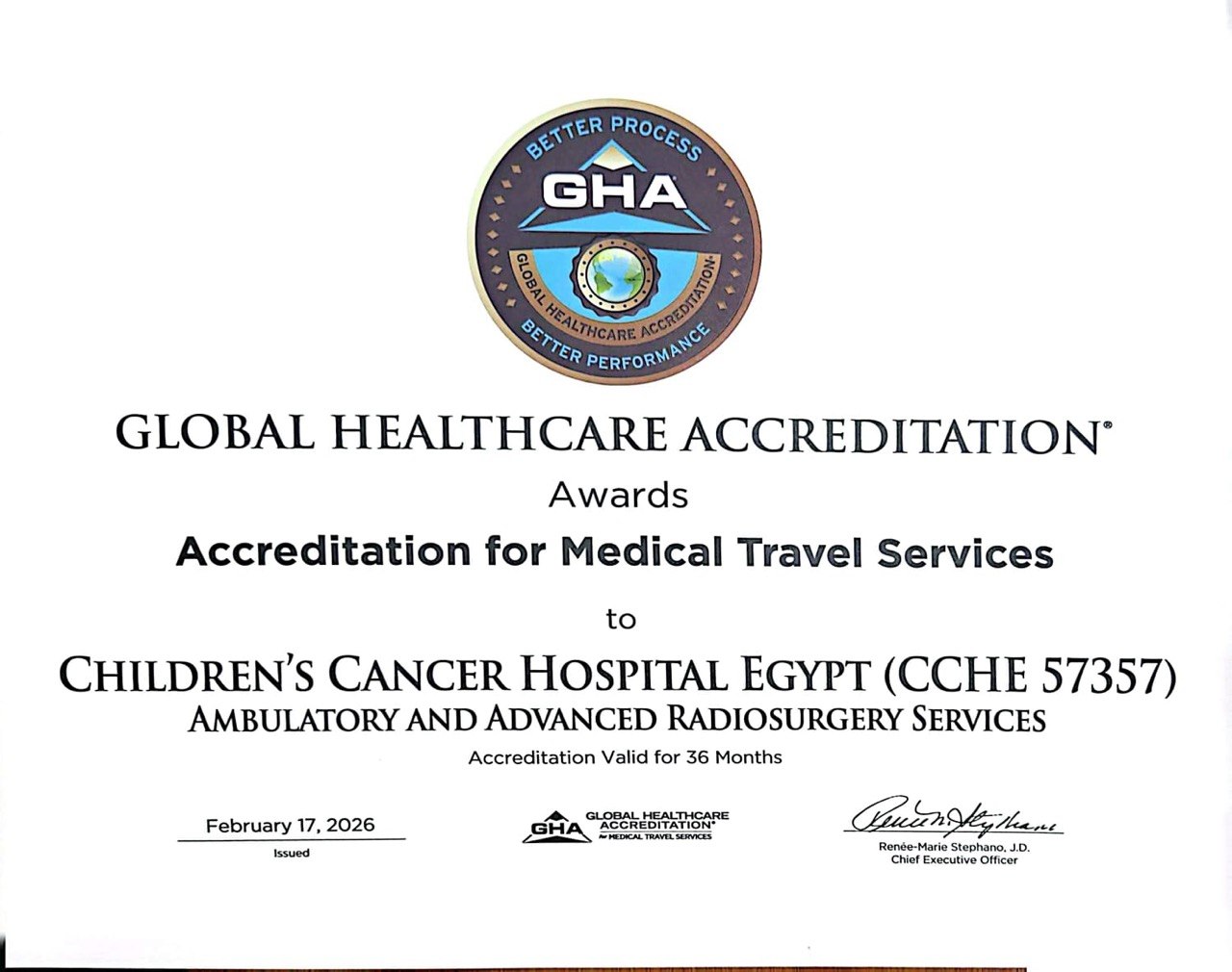
This clinical and technological progress was intentionally aligned with the hospital’s achievement of Global Healthcare Accreditation (GHA) for Ambulatory Services, ensuring that advancements in technology, safety, quality, and global trust evolve together. GHA was never pursued as a technical badge, but as a strategic extension of 57357’s mission. The accreditation provides a structured framework that strengthens safety, transparency, quality, and patient experience, while responsibly positioning the hospital to welcome adult and international patients under globally recognized standards.
Adult patients will receive the same excellence, compassion, and ethical care that define 57357, under transparent and fair pricing. Most importantly, every pound generated through carefully governed service surplus is reinvested directly into protecting and advancing free pediatric cancer care.
Human experience has revealed an even deeper dimension: many adult patients, upon witnessing children receiving world-class treatment entirely free of charge, voluntarily choose to donate and become long-term supporters. What begins as treatment evolves into trust, advocacy, and giving.
Equity stands at the heart of this model. In accordance with GHA principles, Egyptian and international patients are treated equally — under the same standards, pricing structures, and respect. Revenues are governed transparently and reinvested responsibly, reinforcing a culture of integrity, accountability, and trust.
Through the GHA framework, 57357 strengthens operational discipline while ensuring that every surplus-generating service reflects the same rigor and humanity that define pediatric oncology. Together, the cyclotron, proton therapy, CyberKnife, PET-CT, root-cause-driven system redesign, and global accreditation form a fully integrated ecosystem built upon science, humanity, fairness, and sustainability.
Delivering ambulatory clinical services for adults — including proton therapy, CyberKnife, laboratory, imaging, and radiation therapy — with 57357 quality and preferential pricing supports:
• The continuity of completely free treatment for children
• The ability to treat a greater number of pediatric patients
• The advancement of future expansions
• Without impacting the hospital’s core pediatric bed capacity (300 beds)
Every adult patient treated contributes to funding a child’s care.
Every service surplus protects free treatment.
Every system strengthened brings 57357 closer to global survival benchmarks.
Ultimately, every decision at 57357 remains guided by one unwavering purpose:
To ensure that children with cancer in Egypt receive comprehensive treatment entirely free of charge — delivered at the highest possible standard of care, granting them the same chance at life as children anywhere in the world.